Smart Chickens
I knew it. My chickens are smarter than most people. Guess I can’t call anyone a bird brain anymore.
I knew it. My chickens are smarter than most people. Guess I can’t call anyone a bird brain anymore.
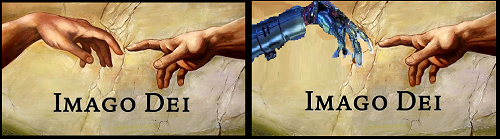
What Lies Beyond the Image of Our Humanity? (30 min)
My comment under the video:
It has been obscured and occulted. Never a truer word spoken. It is Gnostic-Kabbalah expressed as alchemy that has captured science. I am so glad that you eventually mentioned that man is imaging God which was fundamental to the formulation of your constitution. If all men are made in the image then they are essentially equal and have freewill and also have moral obligations towards each other and towards God. It is a sin to destroy the image of God (your fellow man). As the divine representative humanity was given sovereignty and responsibility over the earth and its creatures (doing a good job aren't we? lolz). Render unto Caesar his image (give him back his coin which bears his image) but render unto God the things that are God's because you are made in the image. (Matt 22:21) This is why they were forbidden to construct idols (false images). God has already constructed his image (we are his image). Bio-digital convergence is reformulating humanity to collectively become a (networked) "god" that is omnipresent and omnipotent. It is dystopia on steroids and the erasure of humanity and a direct challenge against God who is consciousness and life itself. It will fail but it will do untold damage and drag many into hell.
Michael Levin is the wizard who can make worms grow two heads or an eye on the back of a fish using bio-electricity.
Don’t you want people to grow new limbs? Don’t you want the blind to see? Are you some kind of retarded Luddite who wants to stop scientific advances. We have our best Jewish alchemist brains working on this. Our Gnostic-Kabbalists have wrestled the secrets of the Universe from Yaldobaoth, Soon we will all be gods and escape this material prison.
This is the science behind the queer futurist theology that Prof Hamamoto exposes in the previous blog article.
Moreover, Alison McDowell has taken clips from this video because this is not just about physical transformation but about the way data and information is passed on (cell memory) and it teaches us about the failure of collective intelligence of the cells (to prevent cancer). That is of course important knowledge when you are building a collective intelligence with people acting as nodes or cells within a larger network. Cognitive glue. This is all about consciousness.
Here is the one minute clip.
Another 1 minute clip. With her abstract thinking Alison draws parallels between bioelectricity and Crypto. Not as fanciful as it seems as they want to create a superorganism linked by the blockchain.
Below are the full videos:
I created a new tag called Consciousness as this lies at the basis of the ongoing experiment that we are now experiencing. Artificial Intelligence will be linked with the collective human brain through technology in order to create a conscious quantum mind with god-like power (so they think).
In their view the universe ( the “superordinate consciousness) functions as data streams that seeks to express itself in a lower dimensional (material) form in order to experience itself in a constant feedback loop.
David Drew: Our Divided Brain | Thunderbolts (38 min)
Michael Levin Addresses Consciousness & the Mind-Body Problem (15 min)
Bioelectric Fields: A Paradigm Shift In Biology | Prof. Michael Levin (1:07 min)
Alison’s approach might seem eclectic and eccentric at times but I believe she has her finger on the beating pulse of the beast and that she can see the emergence of the Noosphere and the collectivization of problem solving and channeling of consciousness and “spirituality” to create a reality where man becomes his own God.
Gestalt, Quakers & Carbon Trading – Looking For The Vase When You’re Presented With Silhouettes (1:52 min)
What they are doing is actually making a Jewish Golem.
A golem is a creature formed out of a lifeless substance such as dust or earth that is brought to life by ritual incantations and sequences of Hebrew letters. The golem, brought into being by a human creator, becomes a helper, a companion, or a rescuer of an imperiled Jewish community. In many golem stories, the creature runs amok and the golem itself becomes a threat to its creator. https://www.jmberlin.de/en/topic-golem
This is about bio-digital convergence and transhumanism. These people are nuts. You do realize that don’t you? No matter how smart they are…they are actually psychopathic nutters on the nutty train to destruction.
A Conversation With Catbriers (Smilax) – Revelations On Boundaries, Detox, and Dionysian Mysteries (24 min)
This was more of an allegorical discussion based on gardening and drawing parallels with the structures being built. The video that I highly recommend is the one below by Michael Levin.
“Novel Bodies, Unconventional Minds: diverse intelligence and the study of consciousness” (1:20 min)
On the one side we have doom and despair and on the other side we have transcendence where the Schumann resonance enables us to achieve higher levels of consciousness (see the last two videos). We can all hold hands and sing Kumbaya as we are hit by bolides (lolz) I think the truth is somewhere in-between. People have survived such catastrophes in the past otherwise you would not be reading this. Huge natural physical changes caused by electro-magnetism, plasma and radiation are on the way. I believe that it will coincide with a theophany. The old age will pass away. Behold, I make all things New. A reset is coming and it is not the one planned by the WEF globalists, Trump or the bankers.
Biden Has Covid-19, Say’s He Will Drop Out Of The Race – Four Asteroids On Collision Course in 2024 (16 min)
CME Impacts Coming, Magnetic Pole Shift Cycle | S0 News July.18.2024 (5 min)
Göbekli Tepe and the Prophecy of Pillar 43 | Apocalypse and the Vulture Stone
Solar Maximum is Raising the Frequency of the Entire Earth (44 min)
These people are nuts. I really mean that. Psychotic psychopaths who will make humanity extinct if they continue with their madness. It seems that is their goal. The end of “project humanity”.
Immortality Is Closer Than You Think: AI, War, Religion, Consciousness & Elon Musk | Bryan Johnson (3:05 min)

In this foray into metaphysics Dr Kevin McCairn interviews Bruce MacDonald and I join the discussion later on. Bruce was born into a very traditional Catholic family but has been on a spiritual journey of discovery. Bruce MacDonald was born in Ottawa, Ontario. He has a journalism degree from Ryerson University in Toronto, Ontario. He has worked in Canada, the United States, and Europe as a technical writer, editor, and designer in the fields of software and telecommunications. In 2014 he moved to the Province of Limon, Costa Rica, where he lives on a small farm in the Talamanca Mountains with his wife, Rosemary. They farm abaca, a male banana plant which produces fiber used to make paper and other products.
Many of these discussions adopt the standpoint that the Old Testament (and indeed the New) are completely fictious without a basis in history. This is an a priori departure point that excludes the existence of characters such as Moses, Abraham and Christ and is a hypothesis that assumes the truth of the conclusion, instead of supporting it (a metaphysical fallacy known as begging the question). Many of these objections were already addressed in a previous article Bruce MacDonald and the Black Arts
The ancient texts are difficult to classify because they do not fit in a single category. As Professor Robert Alter demonstrated they are very stylized literature which contain type scenes and literary conventions. Then there is the layer of intertextual structure, which is the interplay and interconnectedness between different texts, where the meaning of one text is shaped or influenced by its relationship with other texts using allusion, allegory, echo, citation. On top of this we have another layer of informatics as the text encodes alpha numeric values that are related to cosmological cycles. There is therefore a deep layer of complexity which we dismiss at our peril.
My current working hypothesis is that the the biblical revelation (which in my view goes back some 6,000 years) was necessitated to halt the trajectory of humanity and stop the practice of human sacrifice and to halt the human desire to become gods (transhuman) through technology. That does not mean that we should adopt a Luddite view of technology, or the enlightenment brought by the advances of science as our intellect and all the raw materials we have are gifts from God. However, they should not be used to challenge God and impose a new reality (virtual or otherwise) on humanity, nor should they be used to create full spectrum dominance that robs humanity of God given freewill and freedom. If you think that we have somehow left the era of human sacrifice you would be wrong because the philosophy of eugenics which pushes abortion, population control and which is behind the blood letting of the constant wars is a deliberate policy of human sacrifice. War has become the predominant field of human technological advancement and everything we now use from the invention of the internet to communications to Artificial Intelligence to Biological experimentation is from WAR (=human sacrifice). And so, the Biblical story that counters human sacrifice and the hubris of wanting to be God and make our own creation is still valid. If left unchecked, humanity will create hell on earth (and we are getting there real fast). The biblical revelation (which resulted in the birth of Christianity) restrained the “ancient serpent” or what the apostle Paul calls the mystery of iniquity (2 Thess 2:7). And it is indeed a “mystery” because it is hidden “occult” and ancient and it corrupts and subverts everything it touches (even Christianity) but it will not succeed. We are now seeing the re-emergence of the occult which have teamed up with the intelligence services and the military machine to use the current cycle change to bring us a New World Order. The only religion seen as a threat to this new paradigm is true Christianity. The eastern religions are not seen as a threat, neither is Judaism (which is essentially Kabbalah or Gnostic) neither is Islam (Judaism lite). It is only in Christianity that you are told that the root of the problem is human nature and that you cannot save yourself. We carry the seeds of our own destruction with us. The “serpent” principle is ancient and found in all religions, moreover it is connected with cyclical destruction (ouroboros).
Reincarnation is the religious or philosophical belief that the soul or spirit, after biological death, begins a new life in a new body that may be human, animal or spiritual depending on the moral quality of the previous life’s actions. Reincarnation is essentially an Eastern philosophy, and it seems to have been adopted by elements of Judaism. Many scholars will tell you that the Jews had no belief in personal afterlife with reward or punishment in Judaism before 200 BC. (Gowan, Donald E. The Westminster Theological Wordbook of the Bible. Westminster John Knox Press, 2003, p. 188). This of course discounts the fact that even critical scholars date Genesis before the exile (BC 586) and in Genesis the promise to Abraham is personal (Gen 15:8) and the resurrection is implicit as pointed out by Christ to the Sadducees (Matt 22:32) who had no belief in the resurrection. The fact that the very name of God is associated with existence (I Am) and manifestation (I WILL BE) emphasizes this point as well as the throne of God placed in the midst of the living creatures (cherubim) the symbol for creation. The aristocratic priestly class of the Sadducees had therefore a very materialistic view of life denying any afterlife, and this most certainly encouraged them to build dynastic power viewing their progeny as a continuance of their consciousness.
John the Baptist being the reincarnation of Elijah is denied by Christ. He would have been Elijah if they had been willing to receive his message (Matt 11:14) which was one of repentance and preparing for the Messiah. He came in the power and spirit of Elijah (Lk 1:17) but he was not the reincarnation of Elijah. After his disciples questioned him whether John was Elijah, they saw a vision known as the transfiguration where Jesus was conversing with Moses and Elijah. (Lk 9:30). The disciples (formerly disciples of the Baptist) perceived this to be a “kingdom” vision and they may have been transported into the future. Whatever the case may be, this put paid to the speculation that John was Elijah (or a reincarnation of Elijah). The mission of John the Baptist was prophesied in Malachi (https://www.biblaridion.info/Prita_Malachi.png) and typified as Moses and Elijah (the Law and the Prophets) turning the hearts of the children to the fathers (Mal 4:4-5) as in returning the Israelites to the values of the Patriarchs (Abraham, Isaac, and Jacob). The mission of John failed and this was a prelude to the Jews rejection of the Messiah but the mission of Moses and Elijah is picked up again (repeated) in the Apocalypse (see Witnessing prototypes in my PRITA commentary). Suffice to say the mission of Moses and Elijah is a repeat pattern of their message not a reincarnation of the characters themselves. Both Moses and Elijah are known for fighting against false gods. The gods of Egypt (Gnostic=Kabbalah) and the gods of Canaan (human sacrifice). They are false routes to enlightenment.
If resurrection is not reincarnation, then what is it? Scripture speaks of bodily resurrection but what kind of body? This is a question that the apostle Paul answers by a differentiation analogy between types of celestial bodies and animal bodies and he concludes there is a natural body, and there is a spiritual body (1 Cor 15:34-44). We might answer then that it is a “spiritual body” rather than a natural (materialistic) body and that there are different kinds of bodies. However, does this clarify the question? Only if we turn to the resurrected Christ. He possessed a body which suddenly appeared in their midst even though the doors were locked (John 20:19) it was a “body” that could be touched (John 20:27) and handled (1 John 1:1), which could eat even though it required no sustenance (Luke 24:42-43) which they saw go up to heaven (another dimension? Luke 24:5). Which was unrecognisable to them until he revealed himself (Luke 24:31). This is not a natural material body as we understand it. Moreover, Jesus said that flesh and blood (human nature) cannot inherit the kingdom of God but must be born again (or born from above) through means of water and spirit (John 3:5). The principle is first the natural, then the spiritual. Just as a child is born of the waters bursting and the first breath of life so also only death (represented by water baptism Rom 6:3) will result in a spirit birth. As Jesus said. God is Spirit and must be worshipped in Spirit and truth (John 2:24) and the gift of the Holy Spirit in the first century (for the purpose of preaching) was a sign of the powers of the age to come (Heb 6:5). People who are “born of the Spirit” are likened by Jesus to the wind. Although the invisible force of the wind cannot be seen its effects are felt, yet no one knows where the wind originates or where it dissipates. The same with Jesus, they did not know from whence he came or wither he was going. His birth and death were shrouded in mystery. So, it is of everyone born of the Spirit (John 3:8). Jesus committed his Spirit into the Father’s hands (Luke 24:36, cf. Psalm 31:5) which in my view is connected with what science would call consciousness going back to the source of all being. If consciousness is experience of self and one’s environment, then it ceases with death until such time as the node of consciousness that identifies with self is reanimated and that need not be in a material body. It is a different dimension of existence. Everything lives and moves and has its being in God (Acts 17:28) and therefore the Universe itself could be considered a consciousness field but the remarkable thing is that the ground of all being choses to display himself not as an abstract but as a Father reconciling himself to an alienated world and humanity through his Son who is the manifestation of his express image (Heb 1:3)
The Occult Practices of The Apex Predator Class – With Bruce Macdonald (3:53)
In this video Dr Kevin McCairn PhD neuroscientist has a discussion with E. Michael Jones Catholic writer, former professor at Saint Mary’s College in Indiana and the current editor of Culture Wars magazine concerning consciousness and metaphysics. At the conclusion of the discussion after E. Michael Jones leaves, I join Dr McCairn for a chat. Though I differ on the theology it was refreshing to listen to E. Michael Jones and his rational presentation of metaphysics.
My position is that there is a connection between these abstract concepts which are to a lesser or greater degree focused on nature and on the activity of divine agency in the material world. The following short video has an interesting understanding of the role that language plays:
Language is unique in communicating and structuring abstract ideas, crucial to our thought processes and therefore of critical importance to consciousness and metaphysics. It also determines relationships and hierarchical structures. I give my children and my dog a name, they do not name me. When language is combined with mathematics and that is used to describe creation, we are dealing with something uniquely powerful and as far as I can determine this first occurred with the proto-Hebrew language and passed via Phoenician to the Greek language. Below are some initial findings which I hope to express in a separate article, but they demonstrate that Genesis encodes the cyclical nature of the destructive and creative process that was also known to other ancient civilizations. What makes the Semitic approach unique is that it combines language and mathematics (sacred geometry) with revelation resulting in an ontological unfolding of a continuously evolving manifestation of consciousness. The divine name is not just linked with what God is, but with what God will be. Everything lives and moves and has its being in him, ipso fact he is then the source of consciousness and we are nodes in the matrix. The Genesis narrative highlights alienation and existential angst.
"And the eyes of them both were opened, and they knew that they were naked; and they sewed fig leaves together, and made themselves aprons" (Gen 3:7).
The word naked has the following values: ‘ê-rum-mim (naked) עֵֽירֻמִּ֖ם – 360 Standard / 72 Ordinal and 360 x 72 =25,920 years which is the number of years in the Platonic Great Year considered by the ancients (and Newton) to reflect the Precession Cycle. The full Hebrew verse has the standard value 4066 whereas the other verse with the plural form (‘ă·rūm·mîm עֲרוּמִּים std 366 / 78 ord) in Genesis 2:25 has the value 2,626 (std) and 4,066-2,626 = 1,440 (the minutes in a 24-hour day) which is 2 cycles of 720. The figures 72 and 144 (or multiples thereof) are found in all the ancient precession cycle calendars from the Babylonian, Mayan, Indian etc. 18 x 1,440 =25,920
(note that both numbers reduce to 9), moreover the sum of the squares of these two numbers (144^2 +72^2) is also 25,920. The value of the word naked pre-fall (Gen 2:25- 366/78) is different to the value after the fall (Gen 3:7 naked= 360/72). The serpent in Gen 3:1 is described as cunning (crafty, shrewd) with the word cunning having the same values (366/78 both reduce to 6) as naked in Gen 2:25 (before the fall) with the full verse (as we have seen) reflecting double the yhvh name value (2626) reflecting their primeval innocence with emphasis on both male and female imaging yhvh (And they were both naked the man and his wife and were not ashamed) hence the double 26.
That the word naked can when re-pointed and differentially contextualized (cf. Job 5:12 and Job 15:5 עֲרוּמִ֑ים) take on the negative connotation of crafty (=the serpent) demonstrates that the omniscient narrator already anticipates that the idyllic harmony will be ruined by rebellion. The phrase “were not ashamed” (ולא יתבששו) just happens to have the ordinal value of 101 and 26 x 101 =2626 (the std value reduces to 11=2). We saw previously the mathematics and sacred Geometry connected with Genesis 1:1 –
In the beginning God created the heaven and the earth (Gen 1:1)

Std value =2,701 Ordinal =298      בראשית ברא אלהים את השמים ואת הארץ

There is much more, we are just scraping the surface.

The verse triangle can be inscribed in a circle with a radius of 42 units. Adding the seven Hebrew words of Genesis 1:1 in different combinations, one will find 23 multiples of the number 37, including a compound figurate square of 23 hexagrams (37 7²) and cubes of hexagrams (37 2³) and (37 3³). Random chance would indicate only about three multiples. Note that each of the seven words is used exactly twelve times in making up the 23 multiples of 37 (i.e., 913 appears twelve times; 203 appears twelve times, and so on). Here are the gematria and order of each of the seven Genesis 1:1 words: 913, 203, 86, 401, 395, 407. And there is much more (reserved for future articles).
There is therefore a nexus between language, mathematics and nature resulting in the revelation of what John refers to as the Logos in his prologue. The first verse of the Fourth Gospel builds on the geometry of Genesis 1:1 by adding a plinth to the triangle:
John 1:1 In the beginning was the Word and the Word was with God and the Word was God - Ἐν ἀρχῇ ἦν ὁ Λόγος,  καὶ ὁ Λόγος ἦν πρὸς τὸν Θεόν, καὶ Θεὸς ἦν ὁ Λόγος.

Standard =3627, Ordinal= 605

The Triangular plinth of 3627 has 12 divisors with a totient of φ = 2160 which happens to be a Platonic month. The value of the first triangle (2701) and plinth (3627) is equivalent to the 112 th triangular number (6328) which also happens to be the length of the base making the perimeter 333 dots and the product of the digit pairs (63 x 28) is the square of 42 as does the ordinal value of both verses, which sums up to the Triangular number of 42 (903).

Therefore, we have a direct connection between the Genesis 1:1 and that of the Fourth Gospel with the appearance of Jesus on the scene described in terms of creation. Moreover, the name used for Jesus in the Talmud (וּשֵׁי Yēšū) which is often hostile towards him has the ordinal value 37 which is the same as the Hebrew word for wisdom which is in turn the 37th triangular number (666+37 =703) and Yēšū also has the standard value of 316 which is the mirror of 613 the number of commandments (mitzvot) in the Torah (Tractate Makkot 23b). With the word becoming flesh (καὶ ὁ λόγος σὰρξ ἐγένετο : kai o logos sarx egeneto) the word flesh (sarx) in the Greek giving us the value 361 we have the unusual triumvirate of : 316 (Yēšū) 613 (word) 361 (flesh) the sum giving the 1290 days of Daniel 12:11 (from the time that the daily sacrifice shall be taken away…).
A case can be made that all three strands of thought cross-fertilized each other especially as the Fourth Gospel was written to the church at Ephesus and the Gospel emphasized the superiority of Christ over John the Baptist and the influence of Jewish gnostic sorcery (cf. Acts 19) a church that was made known the manifold wisdom (Sophia) of God (Eph 3:10)…. And to know the love of Christ, which passeth knowledge (gnosis), that ye might be filled with all the fulness (pelorma) of God (Eph 3:19). Ephesians is employing gnostic terminology, the problem was that Gnosticism became “secret knowledge” only available to initiates and it tended to regard the material creation as evil and slip into Docetism, namely that Christ’s body was not human but either a phantasm or of real but celestial substance, and that therefore his sufferings were only apparent. For this reason, early Christianity rejected extreme forms of Gnosticism and the Fourth Gospel emphasizes that the Logos became flesh thus emphasizing his physical body and his human nature.
Many Christians use the Latin word incarnation for the Logos which is derivative from the ecclesiastical Latin verb incarno, itself derived from the prefix in- and caro, “flesh”, meaning “to make into flesh” or, in the passive, “to be made flesh” as in the Word became flesh in the Latin Vulgate “et Verbum caro factum” understood as a hypostatic union of the divine nature and the human nature and pointing to pre-existence, co-substantiality etc. More apropos to Johannine usage would be the term phanerōthē (Greek: φανερωθῇ) carrying the idea of manifestation, a word that occurs frequently in the Greek NT, particularly in the Gospel of John with reference to Jesus’ manifesting to Israel (John 1:31), manifesting glory (John 2:1), manifesting truth and light (John 3:21), manifesting the name (John 17:6), manifesting his risen self (John 21:2,14). Jesus is seen by John as the ultimate manifestation of the name (I AM) although a lesser manifestation is encountered in the healing of the blind man whose visage was altered that much as to make him unrecognizable to the crowd who questioned his identity to which he replied with the “I AM” formula; “Some said, This is he: others said, He is like him: but he said, I AM “ (John 9:9 Note that he in italics in the KJV is added by the translator). Jesus explicitly says- “Neither hath this man sinned, nor his parents: but that the works of God should be made manifest (phanerōthē) in him” (John 9:3). In the act of healing the blind man becomes an example of the manifestation of divine power. Moreover, the phrase this is he is the 45 th time that Οὗτος (Houtos) is used in the Fourth Gospel with the other forty-four times referencing Jesus, where it is either translated as this one, or in combination “this man” or as “the same” as in the first occurrence of the gospel; “The same was in the beginning with God” (John 1:2) with all 45 occurrences reflecting the value of Adam in the Hebrew (45), Jesus is depicted as the last Adam ἔσχατος Ἀδὰμ (1 Cor 15:45) the express image (Heb 1:3).
It is thought that the Hellenistic Jewish philosopher Philo merged the Ancient Greek Logos philosophy (the principle of cosmic reason) with the Hebrew concept of Wisdom, God’s companion and intimate helper in creation (See Prov 8 article on wisdom to follow soon). Logos became a technical term in Western philosophy beginning with Heraclitus (c. 535 – c. 475 BC), who used the term for a principle of order and knowledge, but the concept was already in use in the Hebrew scriptures before it was popularized in Greek philosophy. Moreover, sacred geometry, higher mathematics and the length of the Great Precession Year was encoded into the language before it appeared in Greece (watch from 16 mins):
The fact remains that the concept of LOGOS in the Hebrew Bible was earlier than the Greek philosophers and the remarkable “coincidence” that the translation of John 1:1 having the same value as Psalm 107:20 is remarkable.

A rough Timeline demonstrates that the sacred geometry and mathematics in Scripture is earlier than the Greeks and earlier than Hermes Trismegistus / Gnosticism.
The translation used is the KJV of John 1.
In the beginning was the Word, and the Word was with God, and the Word was God.

Note: The absence of an article in the phrase In the beginning rendering In beginning note also the accusative preposition pros indicates movement towards a destination called THE God differentiated from god by the absence of an article. G. R. S. Mead places the prologue of the Fourth Gospel in a gnostic context and is partly correct as it was at Ephesus that followers of the John the Baptist were found (Acts 19:1-3) and the Mandæans (lit. Gnostics—mandā = gnōsis) of the lower Euphrates who are the only known surviving community of the ancient Gnosis.The Sidrā d’Yahyā (Book of John) deal with the life and teachings of John the Baptizer. Mead renders the first verse as; “In Beginning was Mind; and Mind was with GOD” which offers the temptation to substitute mind with “tensor field” or “consciousness” or perhaps translate Logos as “purpose” or “idea” or “reason” until we realize that Logos is translated as Word 208x and as saying 50x in Young’s concordance and sending forth the word is idiom for sending an agent (like a prophet) to speak on God’s behalf. The terms of the Fourth Gospel must be defined by the Johannine corpus because he has his own distinct idiom. Thus, John refers to The Word in three other places, and in each case his allusion is to Jesus the Man. “His name is called the Word of God” (Rev. 19:13). “That which was from the beginning, which we have heard, which we have seen with our eyes, which we have looked upon, and our hands have handled, of the Word of life” (1 Jn. 1:1); that is, they heard his preaching, they saw his miracles, they looked upon him crucified, and they handled him when risen from the dead (Lk. 24:39). “Who bare record of the word of God, and of the testimony of Jesus Christ, and of all things that he saw” (Rev. 1:2). Even this passage, which at first sight seems to require a different meaning for “the word of God” lines up with the others when it is realised that this is the first of a series of triads which meet the reader in Revelation 1 (compare verses 4b, 5a, 7). In fact, “the testimony of Jesus and all things that he saw” is the exact equivalent of 1 John 1:2. The tentative conclusion concerning “the Word” in John 1:1 would therefore appear to be that it means Jesus the Man, and not Jesus the Idea or Purpose.
The identity of the expression: “In the beginning” with Genesis 1:1 has led many to assume that John 1:1 refers to the beginning of the visible creation. But a careful use of the concordance reveals that out of 16 other instances where John speaks of “the beginning”, in no single case does he allude to Genesis 1:1. Admittedly, in two of them he refers to Genesis, but in both instances (John 8:44; 1 John 3:8) the allusion is to the serpent. This, however, is Genesis 3 and not the beginning of creation, when all material things were made by the word of God: “And God said…”
It is impressive to observe that all other occurrences of “the beginning” in John’s writings have to do with the beginning of the ministry of Jesus or the beginning of discipleship or some related idea. A few examples:
“And ye also shall bear witness, because ye have been with me from the beginning” (John15:27).
“And these things I said not unto you at the beginning, because I was with you” (John 16:4).
‘Then said they unto him, Who art thou? And Jesus saith unto them, Even the same that I said unto you from the beginning” (John 8:25).
“For Jesus knew from the beginning who they were that believed not, and who should betray him” (John. 6:64).
“Brethren, I write no new commandment unto you, but an old commandment which ye had from the beginning. The old commandment is the word which ye have heard from the beginning” (1 John 2:7).
“For this is the message that ye heard from the beginning, that we should love one another” (1 John 3:11).
This list should be conclusive. John 1:1 is speaking about the beginning of the ministry of Jesus. Hence, appropriately, the immediate reference to the Baptist: “There was a man sent from God whose name was John” (v.6), a reference which in the traditional exposition is badly out of place. Mark’s gospel is now seen to have exactly the same approach: “The beginning of the gospel of Jesus Christ, the Son of God; as it is written in the prophets, Behold, I send my messenger before thy face” (Mk. 1:1,2). And in Luke’s introduction also: “Forasmuch as many have taken in hand to set forth in order a declaration of those things which are most surely believed among us, even as they delivered them unto us, which from the beginning were eyewitnesses-and-ministers of the Word” (Lk. 1:1,2). Note here also, that, as in John, “the Word” must be Jesus; the phrase “eyewitnesses and ministers” requires this.
So we see that it is a matter of allowing the Bible to interpret itself.
There is much more that I could say but the article would become too long. It is however interesting to note that John the Baptist is and we are explicitly told that he was not that Light (John 1:6-9). The reason for the emphasis on Lights is because the annunciation of the birth of John occurred (see my commentaries) at the Feast of Lights a Feast that celebrated the cleansing and re-dedication of the temple (cf. John 2:21) after the defilement wrought by Antiochus Epiphenes. The birth of Jesus who was six months younger than the Baptist would have seen him presented at the temple at Pentecost as the fruit of the Spirit. The point is that John the Baptist was the forerunner to herald the new temple (Jesus Christ) and the church at Ephesus need to be reminded that despite the unusual circumstances of John’s birth he was not “that light”.
John bare witness of him, and cried, saying, This was he of whom I spake, He that cometh after me is preferred before me: for he was before me. And of his fulness have all we received, and grace for grace (John 1:15-16).
The emphasis is on the superiority of Christ note the use of the word fullness or the Greek pléróma. The Greek pléróma (plērōmatos, πληρώματος) in Gnosticism understands the spiritual universe as the abode of God and of the totality of the divine powers and emanations but a similar phraseology occurs in the Greek version of Isaiah 6:3 (LXX): “Holy, holy, holy, is the LORD of hosts: the whole earth is full (πλήρης/plérés) of his glory”. The root (plē-) expresses totality, and implies full quantity (“up to the max”). DNTT (1,733) notes its cognates (plērēs, plēroō, plērōma) all come from the root (plē-/plēthō) meaning “full in quantity.” Thus plḗthō (“to fill or complete”) refers to “that which is complete in itself because of plenitude, entire number or quantity. . . . the whole aggregate,” WS, 395,96). In Christian theology the totality or fullness dwells in Christ denoting that he received the spirit without measure (John 3:34). So, although there is cross fertilization one need not speak of dependence but rather shared motifs, however, once again we see that the Johannine corpus draws on the Old Testament for conceptual language.
Not only is Jesus depicted as superior to John, he is greater than Jacob (John 4:12), has a greater witness than John (John 5:36), is greater than Abraham (John 8:53), he is before John (John 1:15), and before Abraham (John 8:58) he has the fullness and is the I AM and yet the the Father is greater than him (John 14:28) for he is greater than all (John 10:29). Rater than construct theories to explain these apparent anomalies and contradictions Christians should examine scriptures where it is explained how Abraham “saw my day” because in the mount of the LORD it shall be seen (Gen 22:14) and Abraham lifted up his eyes, and saw the place afar off (Gen 22:4 ) and he called the place Yahweh Yireh or Yah will be seen. The love of God would be manifest in the place where Jesus was sacrificed. This is about manifestation and bearing the name.
In John 1:30 the Greek for ‘preferred’ is literally ‘became’ (γέγονεν, gegonen) and the Greek for man (ἀνὴρ,anēr) is very often used to refer to a husband. A literal reading could therefore just as well be, “after me cometh a husband,who has come before me, for he was first of me”. In the case of Redemption by the kinsman redeemer the one that comes AFTER and takes the place of the dead husband comes BEFORE. Jesus born after John took precedence before him because he had come to raise seed to the dead.

I could continue writing about the Fourth Gospel but this must suffice with some earlier material on John 1:3-4 and staircase parallelism.
Scripture is multivalent and encoded sacred geometry and mathematics in the language before the Greeks systematized their mathematics and their philosophy. The fact that the encoding operates across the Hebrew/Greek language barrier with reference to cosmology and astrophysics is remarkable. Scripture can only be understood intertexually and any deviance from proper hermeneutics leads to error. That said, scripture can be read by a child and the truth can be grasped in a child like manner.
Complexity emerges from simple rules employed iteratively and the outcome of the “causal chain” is the same regardless of the input variables. But who sets those initial rules? As E. Michael Jones inferred, philosophy and rationality will only get you so far as beyond a certain point is unknowable. At this point the believer falls back on faith which in its outworking becomes as real as “data” and is classed as “evidence” of unseen realities (Heb 11:1) as the consciousness of the believer with the help of God the source of all, calls into being the things that are not as if they were (Rom 4:17).
Jesus was superior to all who came before but by his own admission he was not greater than the Father. No man has seen the Father yet whoever saw Jesus in action had seen the Father (John 14:8-10). Unlike Adam he was the perfect image and the face of Jesus is the reflection of God’s glory (2 Cor 4:6). World without end. Amen.
