It is important to examine this subject because it is being used by those who are equating “fallen angels” and the book of Enoch with UFO disclosure and aliens with Nephelim etc. Below the video is the PDF which can be downloaded and I have also added some show notes for clarification. A fruitful discussion with John Brisson from We’ve read the Documents,
Discussion With Brother Paul – Enoch, Jude, Peter – 5/6/2026 (1:16 min)
This in answer to a question: The men of Sodom did not even know that they were angels. They looked like ordinary men. Jude calls them “strange flesh” because they were not flesh. What is the point of sex organs if you don’t have sex and are immortal? The Sadducee made that mistake and assumed that the resurrection body was the same as the physical body, but flesh and blood cannot inherit the Kingdom of God. Jesus’ response is that we will be like the angels and not marry. Why would immortal spirit being need sex organs?
Godhead
The term Godhead is used explicitly by the apostle Paul where he states in (Acts 17:28-29) that we live and move and have our being in him. Paul argues that which may be known of God is manifest in them (those who rebelled referencing the golden calf incident). Paul employs the word manifest (phaneros) because man is made in the image of God therefore the Godhead is not made of stone or a golden calf. They replaced the glory of God with an ox that eateth grass (Ps 106:20 KJV). The Israelites made a copy of the ox faced cherubim and declared that it represented the gods that saved them from Egypt. The cherubim represented the glory of God in his natural and spiritual creation, and the ox (a beast of burden) represented Israel under the law. Thus, they worshiped the creature rather than the creator. On a cosmic scale the Zodiac (from the Greek word Zoe or life) represent the constellations and Taurus being the Bull/Ox in the heavens. God is called the “living God” because he dwells among the Living Creatures (represented by the Cherubim). So, the fullness of the natural and spiritual creation dwells in the Godhead. The vision of Yahweh on his throne in Isaiah 6:3 uses the term fulness “And one cried unto another, and said, Holy, holy, holy, is the LORD of hosts: the whole earth is full of his glory” or the YLT literal: The fullness of all the earth is His glory.’ This ties in with what Paul says about the Godhead: “Beware lest any man spoil you through philosophy and vain deceit, after the tradition of men, after the rudiments of the world, and not after Christ. For in him dwelleth all the fullness of the Godhead bodily. And ye are complete in him, which is the head of all principality and power” : (Colossians 2:8-10). If man is made in the image of God and Jesus is the express image, then then the “fullness” dwells in Christ but according to Paul is completed in us. “Who being the brightness of his glory, and the express image of his person, and upholding all things by the word of his power, when he had by himself purged our sins, sat down on the right hand of the Majesty on high” (Heb 1:3). A new creation has been made in Jesus Christ. Therefore, not necessarily theosis but phanerosis which is only possible through Christ. Godhead does not mean a committee or imply a numerical value but rather describes a quality of divinity.
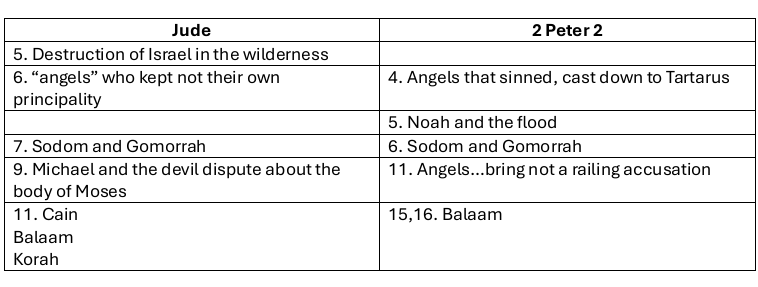
For if God spared not the angels that sinned, but cast them down to hell, and delivered them into chains of darkness, to be reserved unto judgment; 5 And spared not the old world, but saved Noah the eighth person, a preacher of righteousness, bringing in the flood upon the world of the ungodly (2 Pet 2:4-5 )

For Christ also hath once suffered for sins, the just for the unjust, that he might bring us to God, being put to death in the flesh, but quickened by the Spirit: 19 By which also he went and preached unto the spirits in prison; 20 Which sometime were disobedient, when once the longsuffering of God waited in the days of Noah, while the ark was a preparing, wherein few, that is, eight souls were saved by water. 21 The like figure whereunto even baptism doth also now save us (not the putting away of the filth of the flesh, but the answer of a good conscience toward God,) by the resurrection of Jesus Christ. (1 Pet 3:18-21)
Peter and Jude are speaking about the same things and they are rooted in the history of Israel.
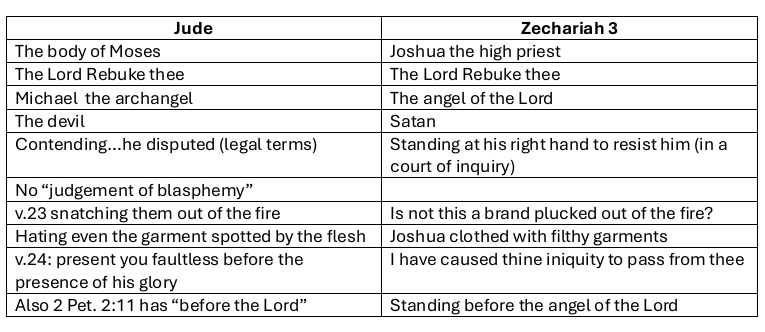
God’s angels do not rebel against him they are ministering spirits. Even “Satan” cannot act outside of divine permission. A house divided cannot stand says Jesus. There is harmony in heaven, and we are taught to pray that God’s will be done on earth as it is in heaven. There is no shadow of turning in the Father. Jude (v.9) even warned, “Yet Michael the archangel, when contending with the devil he disputed about the body of Moses, durst not bring against him a railing accusation, but said, The Lord rebuke thee”. This is a complex text which some refer to an apocryphal writing, but the body of Moses is here probably talking about the nation of Israel (as the Church is the body of Christ) and the incident is Zech 3:2 And the LORD said unto Satan, The LORD rebuke thee, O Satan; even the LORD that hath chosen Jerusalem rebuke thee: is not this a brand plucked out of the fire? This chapter is about the fitness of the post-captivity high priest Joshua to serve, and the “heavenly court” is set up with God as judge and Michael (=who is like God) as angel for the defense and “Satan” as the prosecutor with the accusation (devil=accuser) that Joshua has been made unfit to serve because of the captivity.
Both 1 Peter 3:18-21 and 2 Peter 2:4-5 are talking about the same incident which happened in the days of Noah (in the days of Noah, while the ark was a preparing). The passage is related to water baptism and comparison is made with Noah (saved by water) and the “sprits in prison” (those imprisoned by sin and death). Note the phrase “being put to death in the flesh, but quickened by the Spirit”. There are only a few places where God is called “God of the spirits of all flesh” (Numbers 16:22) and the title is used by Moses the context being the Korah rebellion and an appeal for mercy and the second time it is also used by Moses in the context of his own rebellion when he was told that he would not be allowed to enter the land because he had not sanctified God.
And Moses spake unto the LORD, saying, 16 Let the LORD, the God of the spirits of all flesh, set a man over the congregation, 17 Which may go out before them, and which may go in before them, and which may lead them out, and which may bring them in; that the congregation of the LORD be not as sheep which have no shepherd. (Numbers 27:15-17).
It was JESUS (Joshua) who would lead them into the kingdom not Moses. But note that the “spirits” and “God of the spirits of all flesh” is used in the context of human rebellion against God. We are told that Moses was 120 years old when he died (Deut 34:7) and this is what God said to the generation of Noah: “And the LORD said, My spirit shall not always strive with man, for that he also is flesh: yet his days shall be an hundred and twenty years”(Genesis 6:3). So the “God of the spirits of all flesh” would not allow his spirit to contend with rebellious man forever and therefore the maximum lifespan of the men of renown in the next verse (Nephilim =giants, fallen) was limited to 120 years as was the lifespan of (rebellious) Moses (the meekest of men). There was then a generation of the “sons of God” expelled from Eden who became the exceedingly powerful god-kings (Like the Pharaoh’s etc.) most probably in the line of Cain who became the masters of civilization and city builders (see Genesis ch. 4 ) the descendants of Cain and those of Seth bore similar names as competing dynasty’s “sons of God” and “daughters of men” or those who placed their hope in the messianic promise and those who worshiped the serpent. The messianic line was in danger of being violently expunged when these lines intermarried.
When Jesus visited the realm of the dead (briefly) a first century Jewish or Christian reader would be reminded of Isaiah 14:10-13 were the the King of Babylon/Assyria (here compared to Lucifer) is sent to the realm of shadows where he was mocked by the other Rephaim:
All they shall speak and say unto thee, Art thou also become weak as we? art thou become like unto us? 11 Thy pomp is brought down to the grave, and the noise of thy viols: the worm is spread under thee, and the worms cover thee. 12 How art thou fallen from heaven, O Lucifer, son of the morning! how art thou cut down to the ground, which didst weaken the nations! 13 For thou hast said in thine heart, I will ascend into heaven, I will exalt my throne above the stars of God: I will sit also upon the mount of the congregation, in the sides of the north" (Isaiah 14:10-13)
In contrast Jesus was not permanently condemned to the “underworld” and his conquest of death and its metaphorical inhabitants demonstrates that no part of creation is outside of Gods reach (Ps 139:8).
And again the parable of Lazarus the beggar in Abraham’s bosom and the rich man burning in hell and Lazarus and the rich man are able to speak to each other (Luke 16:20-31), presumably they are talking across the great divide between heaven and hell (the burning man “lifted up his eyes and saw Abraham afar off” in the same manner as Abraham who lifted up his eyes and saw the place of sacrifice afar off (Gen 22:4). It is obviously a parable. See my article on Luke 16 here.
Whatever you make of Isaiah 14 it is about the King of Assyria /Babylon (at one point the Assyrian king conquered Babylon) whose hubris has elevated him to the “mount of the gods” which is a reference to mount Hermon in the north around which the Phoenician Baal myths and Sumerian Titans (Ti.Ta.Na) were absorbed by other Mid-East cultures (including the Greeks) and Enochic Judaism where they become the “rebellious angels” of the book of Enoch which uses the Genesis pre-flood account to frame the Sumerian mythology.
The “angels” (aggelos =messengers) who left their first estate functions as a two-fold reference and warning.
(1) Historical. The reference is to the Korah rebellion in Numbers 16. Korah was one of the 70 (72 with Moses and Aaron, Nadab and Abihu were killed shortly after) elders chosen to go up the mount (Exod 24:1) where the elders had a covenant meal with the Elohim. Hence forth they became the Sanhedrin. The Judges of Israel with the outlook to become the judges of the 72 nations (LXX Gen 10). In other words they were chosen but they rebelled against Moses (God) because they wanted more authority. Indeed it reminds one of the rebellion against Hezekiah in Psalm 82:6-7.
They may well have been elevated to the status of “gods” Elohim (because they received the word of God John 10:35) but they would die like men and like one of the princes. The Korah rebels were swallowed up by an earthquake (chained in everlasting darkness).
I will therefore put you in remembrance, though ye once knew this, how that the Lord, having saved the people out of the land of Egypt,afterward destroyed them that believed not. 6 And the angels which kept not their first estate, but left their own habitation, he hath reserved in everlasting chains under darkness unto the judgment of the great day (Jude 1:5-6).
(2) Apologetic. It also pushes back at the rebellious angels narrative of the book of Enoch. Jude basically says….even your book of Enoch tells the rebellious end up chained in darkness.
And Enoch also, the seventh from Adam, prophesied of these, saying, Behold, the Lord cometh with ten thousands of his saints, 15 To execute judgment upon all, and to convince all that are ungodly among them of all their ungodly deeds which they have ungodly committed, and of all their hard speeches which ungodly sinners have spoken against him (Jude 1:14-15).
This video by Michael Heiser is good and funny. Mind you I don’t agree with everything in his book Unseen Realm but he has some very good points (that I will use). He is correct in saying that this is from the book of Enoch which was not accepted by the church (or by Judaism) as canonical. The passage in Peter is actually a condemnation of Enochic Judaism that lies at the basis of the Gnostic-Kabbalism that is emerging again. This theology depicts Yahweh as a demiurge and his angels as rebellious and the material creation as a “prison of the spirit”. Peter and Jude were aware of the Enochic literature and the Sethian Ophites (see also Mandeism) who venerated the serpent as the illuminator.
“It is a statement of who you are aligned with” says Michael and in this Michael is 100% correct. The believer has passed from death to life.
I will be treating this whole subject in more depth in the future and will also comment on Michael’s book which has interesting observations even though I disagree with some of his premises.
WHO Were The Spirits In Prison That Jesus PREACHED To? (9 min)
Enoch borrows from the book of Daniel. The “watchers” is a Danielic term. Daniel represents the simpler, OT/Tanakh view that the plight of Israel is related to her lack of fidelity to the covenant–NOT to some astrological or angelic super-forces. Boccacinni documents these major differences in worldview for us:
"In the Book of Dream Visions [Enoch], corruption is brought about in creation because the angels' sin directly influences the very possibility of human resistance to evil. It drastically limits human freedom of choice and responsibility. Humankind is thus more the victim than the doer of evil. The degeneration of history is the collective manifestation of a corruption at work against individuals on the ontological level...In Daniel, on the other hand, history degenerates because God has made it the instrument of punishment of the people of Israel who, fully exercising their freedom, failed to meet the commitments of the covenant. Nothing intervened to modify human ability to choose; human beings were and remain free." Middle Judaism: Jewish Thought 300BCE to 200CE. // Boccaccini, Gabrielle // Fortress:1991. (p.149)
"In Daniel we find the same degenerative conception of history that we have seen in the Dream Visions, as well as the same anticipation of the eschatological reign; however, these elements do not have the same meaning for the two authors. The entire course of history is revealed to Enoch, from the creation until the eschatological reign. History is a drama that unfolds with humankind as both protagonist and victim. "All of the men's deeds were shown to me, each in all of their parts" (I Enoch 90:41), states Enoch at the book's conclusion. The explanation of everything that has happened, is happening, and will happen is contained in the Book of Dream Visions, which explains the origin of evil, sets the limits of human freedom, and indicates the characteristics of future salvation....The idea of causality within the unfolding of history corresponds to the apocalyptic idea of a world corrupted by an original sin. For Dream Visions this sin effects its degenerative action in the succession of increasingly iniquitous kingdoms up until the cathartic intervention of God. This concept appears completely extraneous to the author of Daniel, who organizes his thought, as well as the literary structure of the book, around two fundamental ideas: first, sovereignty belongs to God, who grants it and revokes it according to God's will and established times (chaps. 2-7); second, the cause of history's degeneration is the breaking of the covenant, which has brought down upon the people the curse contained therein (chaps. 8-12)." Middle Judaism: Jewish Thought 300BCE to 200CE. // Boccaccini, Gabrielle // Fortress:1991. (p.141)
"As for the retributory criteria of individual judgment, it is clear from the whole of Daniel that it is based on the covenant. The resolution to the problem of the relationship between good and bad deeds, however, is not made explicit. The image of the "steelyard" used in Dan 5:27 is traditional and in itself does not imply a weighing of the quantity of actions. Daniel's words to Nebuchadnezzar are more significant: Daniel advises him to "redeem his sins by practicing righteousness, and his iniquities by showing mercy to the oppressed" (Dan 4:24). These words echo analogous expressions of Ben Sira (cf. Sir 3:3, 14, 30; 35:3), who drew the idea of God's comprehensive evaluation of an individual's actions from the expiatory value of righteous deeds in relation to transgressions. ...In the Dream Visions, judgment has a completely different value. It is more a reestablishment of a corrupted order through an indistinctly operated elimination of both those who are responsible and those who have been involved against their will. Judgment, therefore, is made primarily against the rebellious angels (cf. I Enoch 90:2 1-2 5) and, only by association, human beings and their institutions (cf. I Enoch 90:26-28)." Middle Judaism: Jewish Thought 300BCE to 200CE. // Boccaccini, Gabrielle // Fortress:1991. (p.155)
"As we have seen, even in the judgment of contemporary events Daniel and the Dream Visions take different positions, for anything but marginal reasons. This is an effect, and yet another proof, of the distance that separates them ideologically and makes them witnesses of two independent currents of thought within middle Judaism." Middle Judaism: Jewish Thought 300BCE to 200CE. // Boccaccini, Gabrielle // Fortress:1991. (p.159)
Daniel is thus much, much more "orthodox" than Enochic writings, and the 'political advantage' of borrowing would be on Enoch's side...(Not to get off the subject, but one can trace a progression in the Enochian literature from the more astrological/Mesopotamian beginnings to the 'intrusion and infusion' of Jewish elements. See Enoch and the Growth of an Apocalyptic Tradition. // VanderKam, James C //CatholicBiblicalQuarterlyMonographSeries:1984.