It is important to examine this subject because it is being used by those who are equating “fallen angels” and the book of Enoch with UFO disclosure and aliens with Nephelim etc. Below the video is the PDF which can be downloaded and I have also added some show notes for clarification. A fruitful discussion with John Brisson from We’ve read the Documents,
Discussion With Brother Paul – Enoch, Jude, Peter – 5/6/2026 (1:16 min)
This in answer to a question: The men of Sodom did not even know that they were angels. They looked like ordinary men. Jude calls them “strange flesh” because they were not flesh. What is the point of sex organs if you don’t have sex and are immortal? The Sadducee made that mistake and assumed that the resurrection body was the same as the physical body, but flesh and blood cannot inherit the Kingdom of God. Jesus’ response is that we will be like the angels and not marry. Why would immortal spirit being need sex organs?
Godhead
The term Godhead is used explicitly by the apostle Paul where he states in (Acts 17:28-29) that we live and move and have our being in him. Paul argues that which may be known of God is manifest in them (those who rebelled referencing the golden calf incident). Paul employs the word manifest (phaneros) because man is made in the image of God therefore the Godhead is not made of stone or a golden calf. They replaced the glory of God with an ox that eateth grass (Ps 106:20 KJV). The Israelites made a copy of the ox faced cherubim and declared that it represented the gods that saved them from Egypt. The cherubim represented the glory of God in his natural and spiritual creation, and the ox (a beast of burden) represented Israel under the law. Thus, they worshiped the creature rather than the creator. On a cosmic scale the Zodiac (from the Greek word Zoe or life) represent the constellations and Taurus being the Bull/Ox in the heavens. God is called the “living God” because he dwells among the Living Creatures (represented by the Cherubim). So, the fullness of the natural and spiritual creation dwells in the Godhead. The vision of Yahweh on his throne in Isaiah 6:3 uses the term fulness “And one cried unto another, and said, Holy, holy, holy, is the LORD of hosts: the whole earth is full of his glory” or the YLT literal: The fullness of all the earth is His glory.’ This ties in with what Paul says about the Godhead: “Beware lest any man spoil you through philosophy and vain deceit, after the tradition of men, after the rudiments of the world, and not after Christ. For in him dwelleth all the fullness of the Godhead bodily. And ye are complete in him, which is the head of all principality and power” : (Colossians 2:8-10). If man is made in the image of God and Jesus is the express image, then then the “fullness” dwells in Christ but according to Paul is completed in us. “Who being the brightness of his glory, and the express image of his person, and upholding all things by the word of his power, when he had by himself purged our sins, sat down on the right hand of the Majesty on high” (Heb 1:3). A new creation has been made in Jesus Christ. Therefore, not necessarily theosis but phanerosis which is only possible through Christ. Godhead does not mean a committee or imply a numerical value but rather describes a quality of divinity.
This is a discussion by John Brisson from We’ve read the Documents on the book of Enoch. It is the first of a series that will follow and at some stage I hope to join the conversation.
Why The Book of Enoch Is Not And Should Not Be Canonical – Part 1 – Overview (22 min)
My Comment: An important and difficult theme to examine. I have recently connected some dots between the Enoch problem in the NT and Genesis. It is interesting to note that the Enochian heresy emerged in the early church and is now emerging again. Also not a coincidence that John Dee who coined the term British Empire stated that he had received knowledge from an angel which he wrote in a code he called the "Enochian Language" (Dee was the original 007 and an alchemist in the Tudor court of Elisabeth ca.1600). Add to that the expedition of Charles Warren the Free Mason and theosophist adjacent who surveyed under Solomon's Temple and Mount Hermon (the location of the "fallen angels" in Enoch). After the survey he was appointed as Chief police inspector of the occult ripper murders (sacrifice) in 1888. All a coincidence I am sure.🤣.
Here is my commentary on a screenshot from scholarly book titled Textual and Comparative Explorations in 1 & 2 Enoch, authored by Samuel Zinner.
2./ He was manipulated by traitors and the Evil British Empire. The Brits support the Confederates during the Civil war and assassinated Lincoln. They also assassinated William McKinley. pic.twitter.com/l1H2jNpdtl
6./ Edward got his Jerusalem crusader cross tattoo in Jerusalem. In the same year as the Ripper murders (1888) the Golden Dawn and Rose Cross orders were founded. Edward was the Grand Master of the United Grand Lodge of Freemasons in England and made Knight of the Grand Prior. pic.twitter.com/eYBNLyw3IQ
8./ Walter Bessant was also involved with the Palestine Exploration Fund and sent Warren to survey Palestine.
Warren mapped Solomon’s temple and discovered a limestone stele (a stone slab) with a Greek inscription on Mt Hermon.
12./ This is the Occult Empire that subjected the world and took over the USA. They established the Zionist colony because they hate the Jews. They pathologized the Zionist state. They want to destroy YHWH and Jesus. That does not absolve the Zionists.https://t.co/CUX0fchWXN
How America Fell into Empire: The Golden Circle Revived (CP Podcast with Anton Chaitkin) -1:27 min
Historian Anton Chaitkin lays out the true history of the USA as you've never seen it. Is the republic founded in 1776 a hypocritical fallacy the way many of the leftists proclaim or is it a beacon of liberty that morally has the right to project power onto the world as many among the conservative right proclaim? In this masterclass, Anton Chaitkin demonstrates how foreign agencies centered in London have worked to corrupt the minds and morals of Americans (over the dead bodies of not a few great patriotic presidents) transforming the USA into a racist expansionist asset of the City of London. Anton reveals the Confederate and British imperial forces around Teddy Roosevelt who used this cowboy bigot to enmesh the USA into a new age of secret police operations, eugenics and imperial adventures. Watch the previous class in this series delivered by Sam Labrier here: • In Defense of William McKinley featuring S... Pick up Anton Chaitkin's Who We Are vol 1 here: https://whowearebook.com/ and vol 2 here: https://www.amazon.com/Who-We-Are-Ame... Follow Canadian Patriot for more: 🌐 Website: canadianpatriot.org✍️ Substack: @matthewehret🐦 X (Twitter): @ehret_matthew📘 Facebook: The Canadian Patriot📸 Instagram: @the.canadian.patriot🎙️ TikTok: @the.canadian.patriot📺 YouTube: Canadian Patriot Press
** Teddy Roosevelt’s wife and mother died on the same day in the same house. Something stinks. Further research needed.
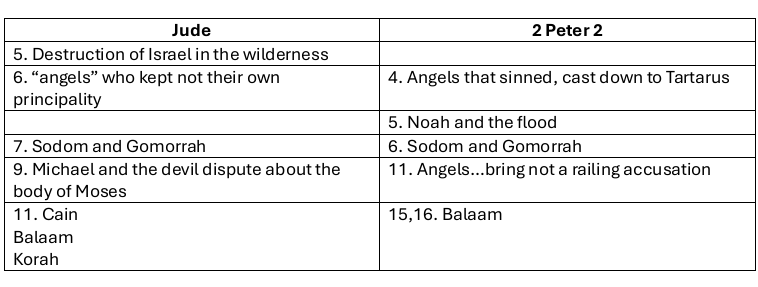
For if God spared not the angels that sinned, but cast them down to hell, and delivered them into chains of darkness, to be reserved unto judgment; 5 And spared not the old world, but saved Noah the eighth person, a preacher of righteousness, bringing in the flood upon the world of the ungodly (2 Pet 2:4-5 )

For Christ also hath once suffered for sins, the just for the unjust, that he might bring us to God, being put to death in the flesh, but quickened by the Spirit: 19 By which also he went and preached unto the spirits in prison; 20 Which sometime were disobedient, when once the longsuffering of God waited in the days of Noah, while the ark was a preparing, wherein few, that is, eight souls were saved by water. 21 The like figure whereunto even baptism doth also now save us (not the putting away of the filth of the flesh, but the answer of a good conscience toward God,) by the resurrection of Jesus Christ. (1 Pet 3:18-21)
Peter and Jude are speaking about the same things and they are rooted in the history of Israel.
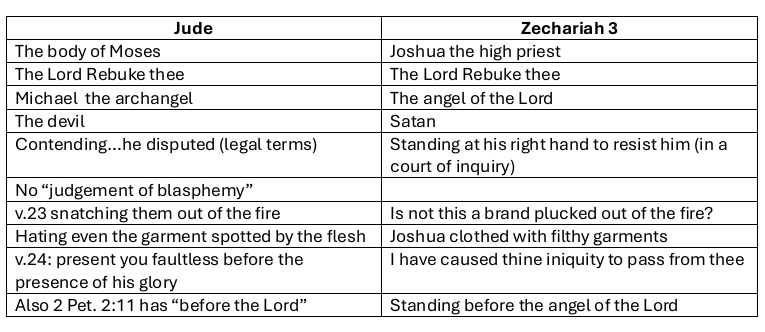
God’s angels do not rebel against him they are ministering spirits. Even “Satan” cannot act outside of divine permission. A house divided cannot stand says Jesus. There is harmony in heaven, and we are taught to pray that God’s will be done on earth as it is in heaven. There is no shadow of turning in the Father. Jude (v.9) even warned, “Yet Michael the archangel, when contending with the devil he disputed about the body of Moses, durst not bring against him a railing accusation, but said, The Lord rebuke thee”. This is a complex text which some refer to an apocryphal writing, but the body of Moses is here probably talking about the nation of Israel (as the Church is the body of Christ) and the incident is Zech 3:2 And the LORD said unto Satan, The LORD rebuke thee, O Satan; even the LORD that hath chosen Jerusalem rebuke thee: is not this a brand plucked out of the fire? This chapter is about the fitness of the post-captivity high priest Joshua to serve, and the “heavenly court” is set up with God as judge and Michael (=who is like God) as angel for the defense and “Satan” as the prosecutor with the accusation (devil=accuser) that Joshua has been made unfit to serve because of the captivity.
Both 1 Peter 3:18-21 and 2 Peter 2:4-5 are talking about the same incident which happened in the days of Noah (in the days of Noah, while the ark was a preparing). The passage is related to water baptism and comparison is made with Noah (saved by water) and the “sprits in prison” (those imprisoned by sin and death). Note the phrase “being put to death in the flesh, but quickened by the Spirit”. There are only a few places where God is called “God of the spirits of all flesh” (Numbers 16:22) and the title is used by Moses the context being the Korah rebellion and an appeal for mercy and the second time it is also used by Moses in the context of his own rebellion when he was told that he would not be allowed to enter the land because he had not sanctified God.
And Moses spake unto the LORD, saying, 16 Let the LORD, the God of the spirits of all flesh, set a man over the congregation, 17 Which may go out before them, and which may go in before them, and which may lead them out, and which may bring them in; that the congregation of the LORD be not as sheep which have no shepherd. (Numbers 27:15-17).
It was JESUS (Joshua) who would lead them into the kingdom not Moses. But note that the “spirits” and “God of the spirits of all flesh” is used in the context of human rebellion against God. We are told that Moses was 120 years old when he died (Deut 34:7) and this is what God said to the generation of Noah: “And the LORD said, My spirit shall not always strive with man, for that he also is flesh: yet his days shall be an hundred and twenty years”(Genesis 6:3). So the “God of the spirits of all flesh” would not allow his spirit to contend with rebellious man forever and therefore the maximum lifespan of the men of renown in the next verse (Nephilim =giants, fallen) was limited to 120 years as was the lifespan of (rebellious) Moses (the meekest of men). There was then a generation of the “sons of God” expelled from Eden who became the exceedingly powerful god-kings (Like the Pharaoh’s etc.) most probably in the line of Cain who became the masters of civilization and city builders (see Genesis ch. 4 ) the descendants of Cain and those of Seth bore similar names as competing dynasty’s “sons of God” and “daughters of men” or those who placed their hope in the messianic promise and those who worshiped the serpent. The messianic line was in danger of being violently expunged when these lines intermarried.
When Jesus visited the realm of the dead (briefly) a first century Jewish or Christian reader would be reminded of Isaiah 14:10-13 were the the King of Babylon/Assyria (here compared to Lucifer) is sent to the realm of shadows where he was mocked by the other Rephaim:
All they shall speak and say unto thee, Art thou also become weak as we? art thou become like unto us? 11 Thy pomp is brought down to the grave, and the noise of thy viols: the worm is spread under thee, and the worms cover thee. 12 How art thou fallen from heaven, O Lucifer, son of the morning! how art thou cut down to the ground, which didst weaken the nations! 13 For thou hast said in thine heart, I will ascend into heaven, I will exalt my throne above the stars of God: I will sit also upon the mount of the congregation, in the sides of the north" (Isaiah 14:10-13)
In contrast Jesus was not permanently condemned to the “underworld” and his conquest of death and its metaphorical inhabitants demonstrates that no part of creation is outside of Gods reach (Ps 139:8).
And again the parable of Lazarus the beggar in Abraham’s bosom and the rich man burning in hell and Lazarus and the rich man are able to speak to each other (Luke 16:20-31), presumably they are talking across the great divide between heaven and hell (the burning man “lifted up his eyes and saw Abraham afar off” in the same manner as Abraham who lifted up his eyes and saw the place of sacrifice afar off (Gen 22:4). It is obviously a parable. See my article on Luke 16 here.
Whatever you make of Isaiah 14 it is about the King of Assyria /Babylon (at one point the Assyrian king conquered Babylon) whose hubris has elevated him to the “mount of the gods” which is a reference to mount Hermon in the north around which the Phoenician Baal myths and Sumerian Titans (Ti.Ta.Na) were absorbed by other Mid-East cultures (including the Greeks) and Enochic Judaism where they become the “rebellious angels” of the book of Enoch which uses the Genesis pre-flood account to frame the Sumerian mythology.
The “angels” (aggelos =messengers) who left their first estate functions as a two-fold reference and warning.
(1) Historical. The reference is to the Korah rebellion in Numbers 16. Korah was one of the 70 (72 with Moses and Aaron, Nadab and Abihu were killed shortly after) elders chosen to go up the mount (Exod 24:1) where the elders had a covenant meal with the Elohim. Hence forth they became the Sanhedrin. The Judges of Israel with the outlook to become the judges of the 72 nations (LXX Gen 10). In other words they were chosen but they rebelled against Moses (God) because they wanted more authority. Indeed it reminds one of the rebellion against Hezekiah in Psalm 82:6-7.
They may well have been elevated to the status of “gods” Elohim (because they received the word of God John 10:35) but they would die like men and like one of the princes. The Korah rebels were swallowed up by an earthquake (chained in everlasting darkness).
I will therefore put you in remembrance, though ye once knew this, how that the Lord, having saved the people out of the land of Egypt,afterward destroyed them that believed not. 6 And the angels which kept not their first estate, but left their own habitation, he hath reserved in everlasting chains under darkness unto the judgment of the great day (Jude 1:5-6).
(2) Apologetic. It also pushes back at the rebellious angels narrative of the book of Enoch. Jude basically says….even your book of Enoch tells the rebellious end up chained in darkness.
And Enoch also, the seventh from Adam, prophesied of these, saying, Behold, the Lord cometh with ten thousands of his saints, 15 To execute judgment upon all, and to convince all that are ungodly among them of all their ungodly deeds which they have ungodly committed, and of all their hard speeches which ungodly sinners have spoken against him (Jude 1:14-15).
This video by Michael Heiser is good and funny. Mind you I don’t agree with everything in his book Unseen Realm but he has some very good points (that I will use). He is correct in saying that this is from the book of Enoch which was not accepted by the church (or by Judaism) as canonical. The passage in Peter is actually a condemnation of Enochic Judaism that lies at the basis of the Gnostic-Kabbalism that is emerging again. This theology depicts Yahweh as a demiurge and his angels as rebellious and the material creation as a “prison of the spirit”. Peter and Jude were aware of the Enochic literature and the Sethian Ophites (see also Mandeism) who venerated the serpent as the illuminator.
“It is a statement of who you are aligned with” says Michael and in this Michael is 100% correct. The believer has passed from death to life.
I will be treating this whole subject in more depth in the future and will also comment on Michael’s book which has interesting observations even though I disagree with some of his premises.
WHO Were The Spirits In Prison That Jesus PREACHED To? (9 min)
Enoch borrows from the book of Daniel. The “watchers” is a Danielic term. Daniel represents the simpler, OT/Tanakh view that the plight of Israel is related to her lack of fidelity to the covenant–NOT to some astrological or angelic super-forces. Boccacinni documents these major differences in worldview for us:
"In the Book of Dream Visions [Enoch], corruption is brought about in creation because the angels' sin directly influences the very possibility of human resistance to evil. It drastically limits human freedom of choice and responsibility. Humankind is thus more the victim than the doer of evil. The degeneration of history is the collective manifestation of a corruption at work against individuals on the ontological level...In Daniel, on the other hand, history degenerates because God has made it the instrument of punishment of the people of Israel who, fully exercising their freedom, failed to meet the commitments of the covenant. Nothing intervened to modify human ability to choose; human beings were and remain free." Middle Judaism: Jewish Thought 300BCE to 200CE. // Boccaccini, Gabrielle // Fortress:1991. (p.149)
"In Daniel we find the same degenerative conception of history that we have seen in the Dream Visions, as well as the same anticipation of the eschatological reign; however, these elements do not have the same meaning for the two authors. The entire course of history is revealed to Enoch, from the creation until the eschatological reign. History is a drama that unfolds with humankind as both protagonist and victim. "All of the men's deeds were shown to me, each in all of their parts" (I Enoch 90:41), states Enoch at the book's conclusion. The explanation of everything that has happened, is happening, and will happen is contained in the Book of Dream Visions, which explains the origin of evil, sets the limits of human freedom, and indicates the characteristics of future salvation....The idea of causality within the unfolding of history corresponds to the apocalyptic idea of a world corrupted by an original sin. For Dream Visions this sin effects its degenerative action in the succession of increasingly iniquitous kingdoms up until the cathartic intervention of God. This concept appears completely extraneous to the author of Daniel, who organizes his thought, as well as the literary structure of the book, around two fundamental ideas: first, sovereignty belongs to God, who grants it and revokes it according to God's will and established times (chaps. 2-7); second, the cause of history's degeneration is the breaking of the covenant, which has brought down upon the people the curse contained therein (chaps. 8-12)." Middle Judaism: Jewish Thought 300BCE to 200CE. // Boccaccini, Gabrielle // Fortress:1991. (p.141)
"As for the retributory criteria of individual judgment, it is clear from the whole of Daniel that it is based on the covenant. The resolution to the problem of the relationship between good and bad deeds, however, is not made explicit. The image of the "steelyard" used in Dan 5:27 is traditional and in itself does not imply a weighing of the quantity of actions. Daniel's words to Nebuchadnezzar are more significant: Daniel advises him to "redeem his sins by practicing righteousness, and his iniquities by showing mercy to the oppressed" (Dan 4:24). These words echo analogous expressions of Ben Sira (cf. Sir 3:3, 14, 30; 35:3), who drew the idea of God's comprehensive evaluation of an individual's actions from the expiatory value of righteous deeds in relation to transgressions. ...In the Dream Visions, judgment has a completely different value. It is more a reestablishment of a corrupted order through an indistinctly operated elimination of both those who are responsible and those who have been involved against their will. Judgment, therefore, is made primarily against the rebellious angels (cf. I Enoch 90:2 1-2 5) and, only by association, human beings and their institutions (cf. I Enoch 90:26-28)." Middle Judaism: Jewish Thought 300BCE to 200CE. // Boccaccini, Gabrielle // Fortress:1991. (p.155)
"As we have seen, even in the judgment of contemporary events Daniel and the Dream Visions take different positions, for anything but marginal reasons. This is an effect, and yet another proof, of the distance that separates them ideologically and makes them witnesses of two independent currents of thought within middle Judaism." Middle Judaism: Jewish Thought 300BCE to 200CE. // Boccaccini, Gabrielle // Fortress:1991. (p.159)
Daniel is thus much, much more "orthodox" than Enochic writings, and the 'political advantage' of borrowing would be on Enoch's side...(Not to get off the subject, but one can trace a progression in the Enochian literature from the more astrological/Mesopotamian beginnings to the 'intrusion and infusion' of Jewish elements. See Enoch and the Growth of an Apocalyptic Tradition. // VanderKam, James C //CatholicBiblicalQuarterlyMonographSeries:1984.
Maybe I am mixed up but I heard something about Trump and a golden shower in a Moscow Hotel room (lolz) I think maybe we are all in for a golden shower.
The Golden Age of America begins….
Indeed it does… golden years ahead…a thousand of them…
Golden Years – David Bowie performed by BLT (feat. the Tahoes) -4 min
These videos were rather good even though I do not agree with everything she says they are important because of the dots that they connect. My next research project will be involved with Enochic Judaism which misinterpreted scripture in order to promote the idea of rebellious angels who interbred with humans and produced the Nephilim giants who were the kings of the ancient world and from whom many of the current aristocrats trace their blood lines. Many of the ancient pagan religions hold the same mythology of god-men (Titans) giants with superpowers (think here of the X-men mutants) derived from hidden alchemical knowledge.
Enochic Judaism is related to Gnosticism and even though the book of Jude and Peter refer to Enochic literature, they do so for apologetic reasons. The book of Enoch was rejected as cannon by the early church. Gnosticism and its synergistic Hermetic partner come from Egypt were the Nag Hammadi literature was found. There we also find reference to another secret bloodline related to Christ and Mary Magdalene that was romanticized by Dan Brown and his DaVinci Code novels. Suffice to say that British Royalty claims to trace its bloodline back to Christ. This explains why the chief wizard alchemist and mathematician, John Dee, at the court of Elisabeth I claims to have received a secret code from Enoch. I believe that a deal was struck by East India Company (with its own intelligence services) with its Jewish Edomite bankers and Zionists who went on to promote Kabbalistic-Enochic Judaism (a type of mystical Gnosticism) of the false messiah Sabbatai (Saturn) Zevi who preached redemption through sin which is similar to Jacob Franks and to Satanist Crowley “Do what thou wilt” who sought to fuse the opposites (good and evil) to create a whole person. Gnosticism seeks to use chaos magic to erase all boundaries and unite all into a singularity. This lies behind the absurdity of creating androgens (neither male nor female) etc. in the desire to create a networked bio-digital collective consciousness. A god-like post-human entity.
The connection between Pan-Saturn-Chronos is interesting but her etymology of the word Elites as in EL (gods) and -ites as in Amalek-ites people of Amalek or descendants of Amalek is forced as it derives from Middle English elit, from Old French elit, eslit (“chosen, elected”) past participle of elire, eslire (“to choose, elect”), from Latin eligere (“to choose, elect”), with past participle electus; see elect. But she has a lot of good material about the “Virgin Queen” and the “Fairy Queen” which links with occultist and spiritualists like Arthur Conan Doyle etc. (Sherlock Holmes) and obsession of the British monarchy with the occult and Solomon’s temple via Free Masonry etc.
This short video is packed with information and although I do not support all her conclusions I believe she is on the right track. I would like to be clear that this is not simply attacking the RC Church because all Christian churches have been subverted and corrupted to a lesser or greater extent (like Evangelical churches with Christian-Zionism) but the RC church is ancient and holds a prominent position and Jewish influence over ancient pagan Rome was bound to transfer to the early RC church and received a boost in later centuries with the Jesuit movement built on converted Jews.
There is definitely an occult input which can be clearly seen in the church architecture (both Catholic and Protestant) with the use of Egyptian Stelae and gothic symbology etc. There is also a connection with nobility who believe they are descendants of Christ in some sort of twisted templar “Dan Brown” way.
I happen to be approaching the problem from another direction, namely, my research points to a strand of Judaism known as Enochian Judaism as the basis for the fallen (Nephilim) mythology on which these noble blood lines base their claims. The book of Enoch was rejected as Scripture by the early church. My current research project is based on understanding and debunking Echonian Judaism.
Another Trump “prophecy” fulfillment (lolz). It is the second short video that really interested me because I watched it was dismissing it as far fetched nonsense when the penny dropped. Her connections with the book of Enoch and Royalty are correct because the Victorian court entertained the Mathematician John Dee (on which 007 is based) who kept a diary in the “Enochian Language” that he supposedly received from angels. This is very interesting because it triggered all sorts of other associations. John Dee was an alchemist and a Gnostic or a believer in Hermes Trismegistus.
This leads to the interesting observation that the book of Enoch was not canonized by the early church and was regarded as apocryphal (fan or fantasy literature). It was popular in the first century BC and for apologetic reasons is even referred to in Peter and Jude. It is on the book of Enoch that many of Gnostic believers base their updated version of “fallen angels” and Annannuki etc being alien beings and all sorts of other UFO-quasi religious beliefs. It is interesting to note that the influence of alchemy and Gnosticism even reaches into the occult circles of British Royalty.
Paula White- JENTEZEN FRANKLIN & the tale of the bloody ear! Prayer & blasphemy breakfast – links 👇 (29 min)
For the uninitiated this definition comes from the ADL website:
"WWG1WGA" is a QAnon acronym and hashtag meaning "where we go one, we go all," used as a rallying cry by the online community of "digital soldiers" that support Q in the battle against the Deep State.
I find it highly amusing that the ADL should think that draining the swamp and fighting the Deep State is somehow antisemitic (lolz). Now anyone with half a brain should know that Qanon is a Psyop from the faction that supports Trump. The letter Q is the 17th letter of the alphabet and is triangular as the sum of the 17 integers is 153 equivalent to the 153 great fishes (megas ichthus) caught by Peter in John 21v11. Moreover, two intersecting circles or the Vesica Piscis, which literally translates as the “Vessel of Fish” forms a fish shape and 153 represents the width of the Vesica Piscis, the Vessel of Fish. Archimedes, a Greek mathematician, physicist, engineer, inventor, and astronomer worked that out. The fish became a Christian symbol. The Greek letters for fish (ichthus) form an acrostic in which the Greek letters are the initials of the words I-ēsous Ch-ristos th-eou hy-ios s-ōtēr meaning Jesus Christ Son of God Savior.
So, the choice of the letter Q is deliberate but this is false Christianity.
ENOCH 6
1. And it came to pass when the children of men had multiplied that in those days were born unto them beautiful and comely daughters. 2. And the angels, the children of the heaven, saw and lusted after them, and said to one another: 'Come, let us choose us wives from among the children of men and beget us children.' 3. And Semjâzâ, who was their leader, said unto them: 'I fear ye will not indeed agree to do this deed, and I alone shall have to pay the penalty of a great sin.' 4. And they all answered him and said: 'Let us all swear an oath, and all bind ourselves by mutual imprecations not to abandon this plan but to do this thing.' 5. Then sware they all together and bound themselves by mutual imprecations upon it. 6. And they were in all two hundred; who descended of Jared on the summit of Mount Hermon, and they called it Mount Hermon, because they had sworn and bound themselves by mutual imprecations upon it.
Interesting that Jared is named (Jared Kushner living at 666 NYC lolz) on the name Shemyaza see the Wikipedia entry.
These people are holding “awakening conferences” and have “prophets” as speakers etc. Here is Flynn with RFK Jr and the degenerate Stone (who has found Jesus lolz).
It's amazing how fast "Christian" Republican supporters switched from Jesus to Trump. It tells you something about their true beliefs. https://t.co/H3gdcz5oZM
I was late joining the debate at 45 mins into this four-hour stream.
Classical vs Gnostic Christianity With John Brisson & Robert Ferrell (4:00 hrs)
Robert Ferrell’s area of expertise is the the Gospel of Thomas from the Nag Hammadi find in 1945. John Brisson is an Evangelical Christian who used to be a Gnostic and recently made a video demonstrating Rockefeller connections with the funding of Gnostic research and publications.
My first point is that in addressing Gnosticism we face an epistemological challenge as claims of hidden knowledge and expertise closes any debate as does any claim of special revelation. The difference with Christianity is that any truth claims are not hidden but open to examination and can be tested with regards to prophetic and historic veracity. Jesus makes a point about transparency: “I have spoken openly to the world, I always taught in synagogues or at the temple, where all the Jews come together. I said nothing in secret” (John 8:20). On the surface this may seem to contradict his penchant for speaking in parables so that, seeing they do not see, and hearing they do not hear, nor do they understand (Matt 13:13) but the parables acted as a filter because anyone who did not understand (like his disciples) could come to him afterwards and ask and he would willingly explain. So, the idea of secret knowledge only available to initiates (which was practiced in many occult religions) was contrary the gospel teachings. There was no special “in-group”.
Robert focused on the similarity of language and concepts found in the Gnostic Gospel of Thomas, but this should not come as a surprise as it comes from a similar milieu as the synoptic traditions, but it has not developed the complex theology and intertextual as scripture. Intertextuality is a hermeneutical strand of poststructuralism whereby texts imbed, reuse, allude to or echo precursor materials so that innovation is grounded in established tradition. Gnostic writings can make no claim to this complex development. In fact, the Nag Hammadi library is an eclectic collection that includes a Gnostic Redaction of Plato’s republic (Coptic translation) and the words of the pagan text “Eugnostos the Blessed” put into the mouth of Jesus as “The Sophia of Jesus Christ”. The Gnostic text is trying to gain legitimacy by attributing the pagan text to Christ. I would suggest that this is the Gnostic modus operandi, namely parasitizing and infiltrating established religions a tactic which was familiar to Judaism who in later centuries syncretized and adopted some of the Gnostic teachings such as the divine sparks found in the Kabbalah. In the complex Gnostic cosmogony Sophia or Wisdom is one of the various emanations of God but in this theology, it is “Wisdom” who rebels against the spirit and creates Yaltabaoth or the demiurge Yahweh of the Bible. That does not sound very wise to me but rather stupid. Thus, the material creation or “prison” is the result of Sophia rebelling. Of course, the opposite is the case in Biblical literature were wisdom is personified or a hypostatization such as in the poem of Proverbs eight and where (Prov 9:10) the fear of the Lord is the beginning of wisdom (the first use of the word afraid is when Adam hid himself from Yahweh in Gen 3:10). The stream Egypt Redux has a transcript and video in which I discuss James Dunn’s research on wisdom in Christology in the Making.
What is referred to as the “Book of Enoch” is actually a collection of three different parts (1, 2 and 3 Enoch) with only 1 Enoch being dated before the New Testament, with a range of 2nd BC – 1st AD according to Charlesworth (The Old Testament Pseudepigrapha (2 vols), Charlesworth, James, (ed). Doubleday: 1983). but more probably close to the Maccabee period ca.167 BC (middle of the range) as the first 36 chapters seem to be pre-Maccabean. The other sections are dated after the NT; 2 Enoch (late 1st AD) and 3 Enoch (5-6th AD). Borger suggests that Enoch could be the 7th king in the Sumerian King list. First, let’s note that the Sumerian version is more elaborate, more ‘spectacular’, more miraculous, and more complex than the biblical version. The surprisingly long-life spans in the bible (i.e. hundreds of years) are DWARFED by the tens of thousands of years in the Sumerian list! The Sumerian heroes of each period are twofold–a king AND a sage–instead of a single leadership figure as in the OT. (Borger in “I Studied Inscriptions from Before the Flood”: Ancient Near Eastern, Literary, and Linguistic Approaches to Genesis 1-11., Hess, Richard, and David Tsumura (eds.), Eisenbrauns: 1994). The function of ascribing a later document to an ancient Israelite hero such as Moses, Enoch, and Joshua is known as pseudepigrapha (or, more properly, pseudonymity), and scholars today are still unsure of exactly why the authors did this…It is not at all clear that they actually intended their audience to believe that, in the case of Jubilees, that Moses actually contradicted himself or omitted portions of his ‘earlier’ work the Pentateuch. A basic methodological principle of comparative studies in the ANE, stated by noted Assyriologist Kitchen is that in the Ancient Near East, the rule is that simple accounts or traditions give rise (by accretion and embellishment) to elaborate legends, but not vice versa. In the Ancient Orient, legends were not simplified or turned into pseudo-history (historicized)… (Ancient Orient and Old Testament., Kitchen, KA, IntervarsityPress: 1966.)
The book of 1 Enoch shares many terms with the OT book of Daniel begging the question if it is dependent (or vice versa). J. Goldingay comments as follows on the Similitudes; “The Parables are uninstanced at Qumran, and current opinion regards them as belonging to the Roman period. Their most interesting parallel to Daniel (more likely suggesting dependence on Daniel than on a common source) is their taking up the humanlike figure and the one advanced in days of 7:13. “That Son of Man” (1Enoch) 46-48, alongside the “head of days” with hair white like wool; see also chaps.62; 69), God’s elect and righteous one, is eventually identified with Enoch (71.14). Thus Daniel 7 is one of the texts that is used to interpret the significance of Enoch and his translation, reported with such tantalizing brevity in Gen 5; and it leads to or justifies a belief in Enoch’s functioning as eschatological judge”. J. Goldingay, Daniel, (Word Biblical Commentary, ed., D.A. Hubbard, G.W. Barker, J.D.W. Watts, R.P. Martin; Nelson Reference & Electronic, 1989), Intro, xxviii. Jude but Peter reference Enoch in a polemical fashion not because they were promoting the pseudepigrapha but because they were countering an antinomian subversion (on this see my article on Fallen Angels).
The priestly and cultic background of 1 Enoch is also increasingly recognised, particularly the role of the Day of Atonement ritual in the “Watchers Cycle” where scholarship understands the story of the “Fallen angels” as a mythological satire against the Samaritan schismatic’s – who (joined by some of the Jerusalem priests) established their own priesthood and form of worship. Moreover, the sending away of the scapegoat to Azazel (= the strong one) on the day of Atonement (Yom Kippur) reflects sending the nation into Babylonian exile (dry places= the wilderness). The only place the word is found in the Hebrew bible is in Leviticus 16: 8-10 as a proper name but it does appear in 1 Enoch where it is embellished into a story about fallen angels and demons. The Expositor’s Bible Commentary (vol 2) suggest that the Aramaic forms point to dependence on Leviticus (Gabelein, Frank E. (1990). The Expositor’s Bible Commentary. Grand Rapids: Zondervan. pp. 590). Be that as it may, Jesus references the Atonement ritual and the Passover ritual and explicitly mentions Azazel (strong one):
Luke 11:21-26: When a *strong [man] armed keepeth his palace, his goods are in peace: 22 But when a stronger than he shall come upon him, and overcome him, he taketh from him all his armour wherein he trusted, and divideth his spoils. 23 He that is not with me is against me: and he that gathereth not with me scattereth. 24 When the unclean spirit is gone out of a man, he walketh through dry places, seeking rest; and finding none, he saith, I will return unto my house whence I came out. 25 And when he cometh, he findeth it swept and garnished. 26 Then goeth he, and taketh to him seven other spirits more wicked than himself; and they enter in, and dwell there: and the last state of that man is worse than the first.
* the word [man] is not in the original Greek
The context of the discussion is the accusation that Jesus is casting out demons by the power of the chief demon Beelzebub. Jesus had cast out the unclean spirt with the miraculous healing of Legion and placed the unclean spirit in the swine that drowned in the “abyss” (Luke). Legion was found healed and sitting at Jesus’ feet listening to the gospel. That is an acted atonement ritual but the unclean spirit is not ritually placed by the priest on a goat and then sent away (into the wilderness) but on an unclean animal (pig) that drowns. The nation had returned from Babylonian exile and found the “house” clean because Jesus had swept the temple and removed the money-changers in imitation of the pre-Passover feast of unleavened bread where Israelites spring cleaned their homes and “removed the leaven” (corruption) in preparation for the Passover sacrifice of the Lamb. Moreover, in the parable, after having gone through the cleansing ritual (exile) the man takes in seven more demons and becomes completely possessed. This is obviously a reference to the dynasty of the high priest Caiaphas and his relatives seven of whom controlled the priesthood until its destruction in AD 70. The “house” was removed because they had gone completely insane. In Jewish lore (probably under Hellenistic influence) Azazel becomes the red, hairy goat like devil. This is a conflation of the biblical story of Edom the brother of Jacob who is described as red and hairy combined with the scapegoat that “bears the iniquity of the nation”and was sent into the wilderness (dry places). Thus, another myth is born. The story of Cain and Able is also based on the Day of Atonement Ritual with Abel being slain (at the entrance to the Sanctuary of Eden) and Cain being sent away into exile (representing the Jewish nation) and being called a vagabond, which term is picked up in Acts 19 when Paul speaks about the “vagabond” Jews and the exorcist Sceva and his “seven sons” which flee the house naked and wounded.
This brings us to Ephesus which was a very important city in Asia Minor (Turkey) and a center of Jewish and Christian interaction. In Church tradition John (the brother of James and disciple of Jesus) took the mother of Jesus (Mary) to Ephesus and looked after her. It is off the coast of Ephesus on the island of Patmos that John is said to have been banished and received the Apocalypse delivered to seven churches in Asia Minor. It is where Paul (in Acts 19) discovers disciples of John the Baptist who had never heard of Jesus (Paul re-baptises them into Jesus). It is also where Paul encounters the “sorcerer” Sceva. It is in my view the destination not only of the Epistle to the Ephesians, but of the Fourth Gospel and the Epistle to the Hebrews (probably written by Barnabas). It is notable that the epistle to the Ephesians contains (in polemical fashion) references to Gnostic theology cf. Ephesians 2:2; “ Wherein in time past ye walked according to the course of this world, according to the prince (archon) of the power of the air, the spirit that now worketh in the children of disobedience” (Eph 2:2) which is juxtaposed with “the adoption of children by Jesus Christ to himself” (Eph 1:5) and what then of Kosmokrator (see my article) which is the counterpart to the angel of death. These are polemical texts addressing the attack on the church by gnostic and Judaistic elements. The Fourth Gospel should also be understood against this background particularly with reference to the Prologue which de-mythologizes and reuses Platonic, gnostic and Philonic terms in a masterpiece of bringing out new meaning. The gap between the Greek philosophic understanding of form and pure reason was bridged by the essence or LOGOS becoming material in the person of Jesus Christ which Christians refer to as incarnation (I prefer manifestation) this is why Christians rejected the docetic/gnostic teaching that Jesus was not real (he was just a ghost or spirt) and not flesh or blood which becomes a litmus test in the first century (1 John 4:1-3). Gnosticism was rejected by the early church. However, “Gnostic language” is encountered (Proarkhe (“before the beginning”, Greek: προαρχή), Arkhe (“the beginning”, Greek: ἀρχή)) with John the Baptist explicitly stating (though using different Greek): “This (Christ) is he of whom I said, After me cometh a man which is preferred before me: for he was before me”. (John 1:30). One of the reasons for writing the gospel of John was to demonstrate the superiority of Christ over the patriarchs and John the Baptist. The synoptic gospels and the Fourth Gospels are not “history” (but they contain history) they are not biographies (but they contain biographical material) they are not theology (but they contain theology) they are sacred history, and each gospel is different because they were written to counter specific problems in the church using Jesu’s ministry as an example and were sent to different churches (audiences). And they all concentrate (focal point) on the Passion narrative (last week). The Fourth Gospel is enigmatic because its style is so different and is seen as late and therefore unhistorical. However, the scholar John A.T. Robinson (Redating the New Testament/The Priority of John) following his mentor Dodd argues the case that the writer had access to very early material. This would make the gospel both early and late (do you see the problem?). The Rylands Library Papyrus P52, also known as the St John’s fragment, was discovered in Alexandria and has been dated by different scholars in a range from 100-150 AD and 125-175 AD. My own investigations (especially the story of Nathaniel) show connections with the Bar Kochba revolt (ca.132-135 AD) where the false messiah was recognised by the chief Rabbi (Akiva), but this does not mean that it is ex-eventu (John 5:43 I am come in my Father’s name, and ye receive me not: if another shall come in his own name, him ye will receive.) I can recommend Andersons’ book The Fourth Gospel and the Quest for Jesus: Modern Foundations Reconsidered although I am not in complete agreement with his historical outline of Johannine Christianity (pp. 196-199). As to Hebrews, it demonstrates (in my view) awareness of the problem in Ephesus; Therefore leaving the principles of the doctrine of Christ, let us go on unto perfection; not laying again the foundation of repentance from dead works, and of faith toward God (Hebrews 6:1), this is the Baptism of Repentance (of John the Baptist): “If they shall fall away, to renew them again unto repentance; seeing they crucify to themselves the Son of God afresh, and put him to an open shame” (Hebrews 6:6). In other words, you cannot progress from the Baptism of Repentance (John) to the baptism of Jesus and then revert to John. It is my view that the Gnostic Mandeans who revere John the Baptist and who now live in Australia (as Iraqi refugees) and practice multiple washing and Baptisms originated with the movement in Ephesus that Paul discovered. Moreover, the message to the Hebrews (Jews at Ephesus) corresponds with the message given by Christ to Ephesus in the Apocalypse.
Note that the message in Revelation 2:1-7 to Ephesus is based on the garden of Eden and with the seven branched candlestick (menorah design is based on a tree) symbolizing the tree of life (v.7).
And the Correspondence between Hebrews and Ephesians:
The Gnostics at Ephesus claimed superiority of “illumination” (compare the Illuminati) or special knowledge brought by the serpent in Eden. Not illumination by God’s spirit. Then there were the Judaists who claimed superiority via the Law. At some historical point Judaists and Gnostics syncretized certain doctrines in the Kabbalah which together with the Kybalion became the New Age teaching of the technocrats (full title: The Kybalion: A Study of the Hermetic Philosophy of Ancient Egypt and Greece) is a book originally published in 1908. And so we have gone full circle from Egypt the home of Hermetics, alchemy, magic and illumination. It was Egypt were Moses challenged the Hermetic “magicians” Jannes and Jambres by casting down a serpent (2 Tim 3:8). Paul warns Timothy to avoid profane and vain babblings, and oppositions of science (gnosis) falsely so called (1 Timothy 6:20). It is ironic that the KJV should translate gnosis as “science” almost as if they are pointing towards ancient Hermetic alchemy and transformation as practiced by the transhumanist science in their quest for immortality. The serpent and the Eden mythology is key to Gnostic theology which points to ancient pre-Sumerian origins. From the Serpent, Nawcash, in the Garden of Eden; Atum, the Egyptian snake-man; and Quetzalcotl, the feathered serpent god of the Mayans to the double-helix snake symbol of Enki/Ea in ancient Sumerian literature, the serpent has been the omnipresent link between humans and the gods in every culture.
Do the “Lizard people” represent a priestly class that practiced head binding (as among the Peruvian elite)? When it says that the serpent was more subtil than any beast of the field which the LORD God had made (Gen 3:1) is the beast a reference to an empire (like they are in Daniel) eg. the Ubaid. (??). The symbol of cyclical destruction is the ouroborus (snake eating its own tail) with reference to the 25,920-year “Precession Year” when creation is unmade and “reset” (The Great Reset). It seems to me (still examining the idea) that the serpent story represents two different ways of overcoming the existential threat, namely, to transcend and become gods through knowledge and science (Gnosticism-transhumanism-technology) or through faith in the promise delivered to Eve and the Abrahamic Revelation which rejects both the Hermetic/Gnostic approach and the superstitious approach of sacrificing children to a “solar deity” to appease wrath. If I am correct, then the ancients were aware of cyclical destruction and solar flaring, and this seems likely as our ancestors must have survived previous catastrophes. Someday I must write a book about the subjects that I have only briefly touched upon here, but I feel we are running out of time. I chose to follow the path of faith, believing that life has purpose and meaning and that the fear of God is the beginning of wisdom. Here are more resources which include links to my articles on Ephesus (three articles)
Search the Gnostic tab on my blog for further resources.
 13 For such are false apostles, deceitful workers, transforming themselves into the apostles of Christ. 14 And no marvel; for Satan himself is transformed into an angel of light. 15 Therefore it is no great thing if his ministers also be transformed as the ministers of righteousness; whose end shall be according to their works. (2 Corinthians 11:13-15)

3 But I fear, lest by any means, as the serpent beguiled Eve through his subtilty, so your minds should be corrupted from the simplicity that is in Christ. 4 For if he that cometh preacheth another Jesus, whom we have not preached, or if ye receive another spirit, which ye have not received, or another gospel, which ye have not accepted....(2 Corinthians 11:3-4 )